How to Identify a Counterfeit Sp5der Hoodie: The Comprehensive Authentication Guide
The Sp5der hoodie has a major counterfeit issue, and in 2026 it is worse than it’s ever been. As the label’s resale prices have gone up and its cultural standing has increased, a thriving underground industry has emerged dedicated to producing fake spider hoodies that look convincing enough — visually at least — to deceive buyers who aren’t sure exactly what to look for. These fakes span from comically poor imitations that no one who has held a genuine Sp5der hoodie would be deceived by, to premium-grade fakes that need thorough in-person scrutiny to differentiate from genuine pieces. This guide examines every inspection area every purchaser should review, from material texture and build quality to tag specifics and design quality. Whether you’re purchasing through a peer-to-peer platform, assessing a pre-owned piece, or simply wanting to authenticate that the hoodie you already own is the real thing, these approaches will provide you with the skills to verify your piece confidently. Being informed is the best protection against counterfeit sp5der clothing, and the checkpoints outlined here are what separates real Sp5der manufacturing from counterfeit versions.
Assess the Fabric Weight and Hand Feel as Your First Step
The first thing to do when assessing a claimed authentic Sp5der hoodie is assess the fabric by hand, because real Sp5der garments use a heavyweight cotton fleece that fakes consistently fail to copy faithfully. An authentic Sp5der hoodie will feel thick and weighty when you hold it — the kind of weight that causes the hoodie feel genuinely premium rather than flimsy. Most imitations use thinner, lower-quality fleece that is noticeably softer and thinner, often with a somewhat plasticky hand feel that is obvious right away to someone who has handled a real Sp5der garment. The inner brushed surface of a real Sp5der hoodie is smooth and uniform throughout, with no uneven areas, irregular brushing, or areas where the brushing thins out. Imitation spider hoodies commonly have a polyester-blend fleece rather than the cotton-heavy blend of the real thing, and this synthetic content www.spiderhoodie.org/sp5der-t-shirts/ is identifiable both by touch and by the how the material reflects light slightly differently than natural cotton. Squeeze the sleeve cuff of the hoodie between your fingers and observe how it responds: real Sp5der fleece has sufficient weight to return to shape gradually and stay structured, while imitation fleece typically collapse under pressure and feel weak. If you are not in a position to examine by hand the garment before purchasing, get close-up shots of the fabric from the seller and check for the density cues in the look and drape of the material.
Inspect the Spider Web Print with Care
The web print is the most noticeable visual feature of any Sp5der hoodie and thus the feature that counterfeit producers spend the most time trying to recreating — but thorough checking regularly exposes clear quality differences. On a real Sp5der hoodie, the spider web print has clear, well-defined lines with no bleeding, fuzz, or edge irregularities of the design. The paths of the web keep uniform width throughout the graphic, even at crossing points and along curved sections where inferior print techniques tend to introduce inconsistencies. Print color depth on genuine Sp5der graphics is impressively strong — especially with vivid colorways like hot pink, yellow, or electric blue — and the color is consistent across the entire design without color inconsistencies that point to poor color distribution. Fake spider hoodies commonly display dull, faded colors, uneven line thickness, and small imperfections in the web geometry that are slight but noticeable to an experienced eye. Graphic positioning is yet another critical checkpoint: on real garments, the web graphic is located in the same consistent spot in relation to the hoodie’s construction lines, while fakes commonly have subtle placement variations. When evaluating photos or looking at the garment in person, closely examine the web line crossing points — authentic Sp5der show clean, precise intersections, whereas imitations often have small imperfections or blobs at these precision-critical locations.
Examine Crystal Work on Applicable Styles
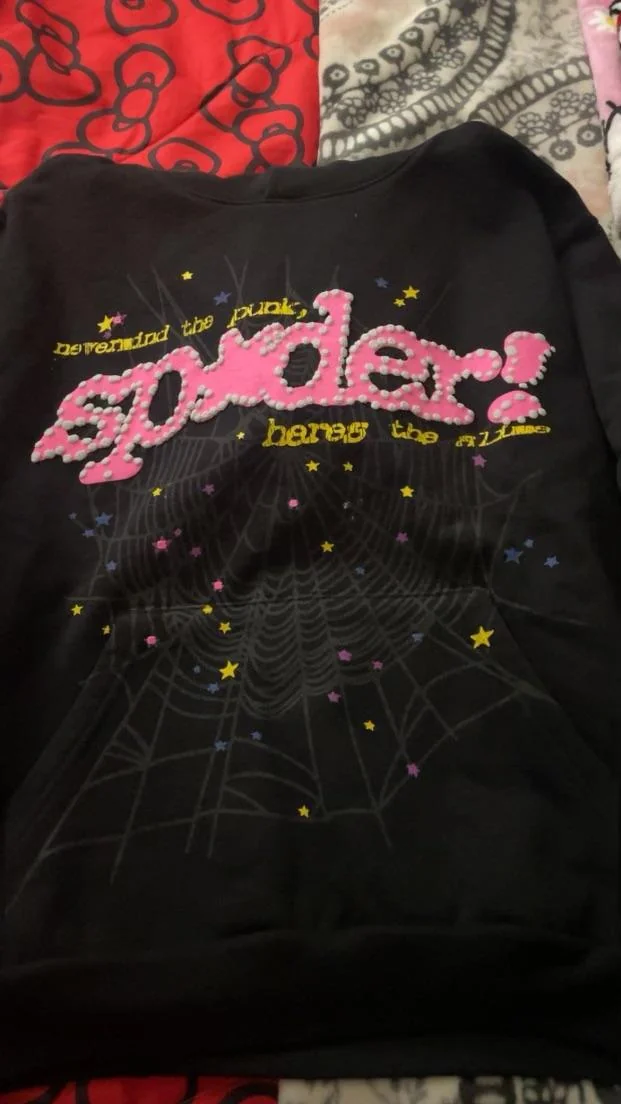
A large number of Sp5der’s most sought-after and most frequently faked hoodie models incorporate crystal embellishments, and the difference in quality between genuine and imitation rhinestone application is one of the clearest authentication checkpoints at your disposal. On authentic Sp5der hoodies, crystals are placed individually into the fabric using a method that ensures each crystal is securely embedded, accurately positioned, and flat with the material around it. Glide your hand over the rhinestone section of a genuine hoodie and you will feel a smooth, consistent texture with no protruding settings and no unsecured crystals even with repeated wears and washings. Fake spider hoodies generally apply heat-applied rhinestone panels, which are applied as a single unit rather than individually set, and these panels have an identifiable look: edges that lift slightly where the panel meets the material, an inflexible texture compared to separately placed crystals, and a tendency to show peeling or separating edges after minimal wear. The stones on counterfeit pieces are often noticeably less brilliant, smaller, or less precisely faceted than authentic quality stones, resulting in less visual impact and a cheaper overall appearance. Examining the reverse side of the fabric at the embellished section is equally informative: genuine individual setting shows tiny, regular anchor points, while stick-on panels create a flat, even reverse side that is immediately distinguishable. Any rhinestones that come away on a brand-new hoodie should be treated as a serious warning sign, as real Sp5der embellishments is remarkably resilient.
Check the Inside Labels and Tags
Internal tagging serves as an essential authentication checkpoint because counterfeiters seldom spend sufficient effort in reproducing the precise typography, material, and placement of genuine brand tags. Genuine Sp5der pieces includes tags with clean, precise printing — every letter is sharp and uniformly formed, with no blurred edges, image pixels, or variation in letter weight. The label material on real garments has a specific texture and rigidity that sets it apart from the inferior woven or screen-printed tags used on most imitation hoodies. Font matters significantly: the unique character forms used in the Sp5der logo have distinctive characteristics that fakes often reproduce inaccurately, particularly the numeral “5” which should align with the label’s established font style perfectly. Wash care labels on genuine Sp5der pieces are always in the same place and use standardized symbols and text that match across all authentic garments. Care labels should state a cotton-primary fabric blend matching the fabric’s actual heavyweight fleece construction — a label claiming polyester-dominant composition on a piece claiming to be genuine Sp5der is an immediate authenticity red flag. Fake labels typically lack substance or have slightly misaligned stitching where they attach to the garment, whereas genuine brand labels are attached with the same quality as the rest of the garment’s construction.
Genuine vs. Imitation Sp5der: Main Differences Breakdown
| Inspection Criterion | Authentic Sp5der | Fake Piece |
|---|---|---|
| Fabric heft | Heavy, dense cotton fleece (380–420 GSM) | Light, thin, often synthetic blend |
| Spider web print lines | Sharp lines, even thickness, precise crossings | Blurry edges, uneven strokes, imperfect crossings |
| Rhinestone setting | One-by-one placement, flush finish, firmly attached | Iron-on panel, lifted borders, peels fast |
| Color saturation | Vivid, consistent, edge-to-edge uniformity | Desaturated, uneven zones, faded appearance |
| Interior tag printing | Clear letters, accurate font, premium label | Fuzzy text, incorrect font, poor-quality label |
| Seam construction | Dense, uniform, consistent across the garment | Slack, irregular, inconsistent stitch tension |
| Drawstring metal work | Metal eyelets, quality aglets | Plastic eyelets, flimsy aglets |
Assess Stitching and Metal Details on the Entire Piece
Beyond the graphic and fabric, the manufacturing specifics of a Sp5der hoodie provide valuable authentication information that counterfeiters frequently neglect in their cost-cutting. Real Sp5der thread work is dense and even throughout the garment, with stitches per inch that reflect high-end build quality — when you look at the stitching closely, the stitches should be uniform in size and spacing with zero loose threads or absent thread passes. Double-stitched seams at areas of strain like the wrist cuffs, front pocket, and hem are a characteristic of authentic pieces that most counterfeits skip in favor of simple single-thread stitching. Metal component details are another area of distinction: the steel eyelets through which the drawstring cord runs on an authentic piece are uniformly finished and sit flush with the fabric, while imitation eyelets are frequently made of plastic, imprecisely set, or show inconsistent sizing. Drawstring tips — the tips on the drawstring ends — on genuine pieces align in quality and appearance of the other hardware elements, while fakes often use low-quality cord tips that feel hollow or lightweight. Checking the kangaroo pocket stitching is highly informative, as this stitch runs along a long stretch that shows whether the consistent stitching quality is upheld or falls apart in less-seen sections. According to authentication professionals at StockX, evaluating seam construction continues to be one of the most dependable ways to verify authenticity for streetwear garments because it indicates comprehensive build quality that cannot be easily faked.
Turning to Authentication Professionals in 2026
For buyers who are not yet confident in their capacity to verify Sp5der pieces without help, paid authentication platforms give a valuable layer of protection before committing substantial funds. Platforms like Legit Check App and CheckCheck provide online authentication where users submit thorough photographs of a hoodie and obtain an opinion from trained authenticators within several hours. These platforms have developed their Sp5der auth capabilities considerably by 2026 as interest has increased, and their accuracy rates for detecting counterfeit Sp5der hoodies are high when buyers submit comprehensive, well-lit photographs covering all the critical checkpoints described in this guide. The fee for online authentication — usually $5–$20 — is minimal when weighed against the price of a real Sp5der garment and the financial loss of getting a fake. In-person authentication at local streetwear consignment stores that are dedicated to streetwear is a further avenue, particularly useful for shoppers who’ve already obtained a suspicious garment and want a physical examination by a trained professional. Some buyers also rely on crowdsourced opinions — Reddit groups like r/Sp5der and r/streetwear are home to knowledgeable enthusiasts who are usually glad to review authentication photos and offer authentication views. Establishing a foundation of auth expertise, whether through formal services or community engagement, is among the smartest moves a dedicated Sp5der enthusiast can take in 2026. Discover more thorough auth resources and community conversations at Highsnobiety, which consistently reports on counterfeit awareness in the streetwear industry.